AntiDebug
Overview
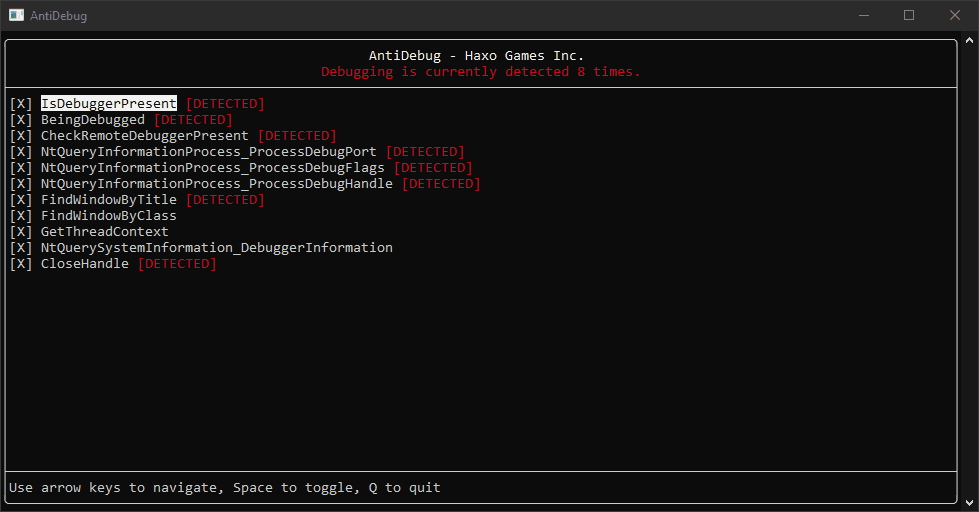
AntiDebug is a TUI-based sandbox to experiment with common anti-debugging techniques (currently user-mode only). I originally made this project back when I was working as the CTO of Haxo Games Inc. (a now defunct company). You can find it on my Github here.
Detections
IsDebuggerPresent
IsDebuggerPresent is a Windows API function that simply accesses the BeingDebugged boolean from the thread environment block (TEB) of the current process. This value
is true when the process is being debugged. This can be bypassed by simply setting BeingDebugged to 0. Patching IsDebuggerPresent may seem idiotic since anyone with a
minimum of common sense would not invoke it directly, and yet most programs out there do.
BeingDebugged
This technique directly reads the BeingDebugged member of the process environment block (PEB) for the current process. If true, it is being debugged. Can be bypassed by
simply setting the value to 0.
CheckRemoteDebuggerPresent
CheckRemoteDebuggerPresent is a Windows API function which which calls NtQueryInformationProcess for the ProcessDebugPort value under the hood. If this value is 0
no debugger is attached, otherwise it sets the pointer to the boolean it was passed to true. This can be bypassed by hooking NtQueryInformationProcess or the function
itself. ProcessDebugPort being in the EPROCESS structure it is immune to usermode shenanigans.
NtQueryInformationProcess
NtQueryInformationProcess can be used to get ProcessDebugPort which can indicate if a debugger is present. It can also query a few values in an undocumented way such
as the heap flags (ProcessDebugFlags) and the debug object handle (ProcessDebugHandle).
FindWindowByTitle
Searches for debugging tools by enumerating windows and checking their titles. It searches for substrings in window titles such as "Cheat Engine" or "Process Hacker".
The substring matching provides flexibility to detect multiple versions of tools even when version numbers are appended to titles. This can be bypassed by hiding debugger
windows, changing window titles and hooking FindWindowExA functions.
FindWindowByClass
Searches for debugging tools by enumerating windows and checking their classes. It uses FindWindowA from Windows API to detect specific window classes like "OLLYDBG" and "WinDbgFrameClass",
This can be bypassed by hiding debugger windows, changing window classes and hooking FindWindowA/FindWindowExA functions.
GetThreadContext
GetThreadContext is a Windows API function that retrieves the current thread context, including hardware debug registers (Dr0, Dr1, Dr2, Dr3). When hardware breakpoints
are set by debuggers, the corresponding debug register contains the breakpoint address. This technique checks if any of these registers contain non-zero values, indicating
active hardware breakpoints. Hardware breakpoints are preferred by advanced debuggers since they don't modify process memory. This can be bypassed by clearing debug
registers before detection, hooking GetThreadContext to return clean registers.
NtQuerySystemInformation
NtQuerySystemInformation can be used to get DebuggerInformation. It's an undocumented structured made up of three booleans:
DebuggerAllowed is true when a kernel debugger is allowed on the system. This will usually become true when the system gets a debugger attached to it. KernelDebuggerEnabled will
be true if the kernel was initialized with debugging enabled. DebuggerPresent is true when there currently is a debugger attached to the system.
CloseHandle
When closing an invalid handle an EXCEPTION_INVALID_HANDLE (0xC0000008) will be raised if a debugger is attached. This can then be cought by an __except block once the debugger passes
control back to the procediss. If no debugger is present no exception is thrown. This detection is disabled by default because it causes an exception.
DbgPrint
This method will raise the exception DBG_PRINTEXCEPTION_C (0x40010006). If it is handled by the program itself then no debugger is attached. Otherwise one obviously is. It is usually is raised
by functions like DbgPrint.
NtGlobalFlag
NtGlobalFlag is a member of the PEB which, when a debugger is attached, has three bit flags set to 1 notably: 0x10: EAP_ENABLE_TAIL_CHECK, 0x20: HEAP_ENABLE_FREE_CHECK and 0x40: HEAP_VALIDATE_PARAMETERS.
Bypassing is as simple setting it to any value that does not match any of those flags (0 will work great). Also it seems these flags are only set when a program is launched with a debugger. When it is attached
after startup they aren't.
EnumDeviceDrivers
EnumDeviceDrivers just enumerates the different loaded device drivers. Debuggers can be detected by looking for signed debugger-related kernel drivers such as dbk64.sys
used for DBVM.
CyclesPassed
CyclesPassed uses MSVC intrinsics to check if the CPU cycles delta between function's prologue and epilogue was abnormally huge. If such a thing happend more than or equal 3
times then it assumes that there was a breakpoint set inside it.
IsWindowsFunctionBreakpointed
IsWindowsFunctionBreakpointed scans for the first 1 or 2 bytes of WinAPI functions (mostly those used for anti debbuging) for software breakpoint INT3 (0xCC / 0xCD03)
and undefined opcode which can be used to throw an exception (0x0F0B).
 Subscribe